After the Final Bell: How Earlsfield ABC Helps a Boxer Carry a Loss

Saturday night, somewhere in south London, under lights that are far too bright for a hall. The result gets read out, a hand goes up, and it isn't your child's. The crowd claps politely for both boxers, because that's what this sport does. Then the gloves come off, and the real work of the evening begins.
Losing is part of amateur boxing in a way that surprises a lot of families. Even very good boxers lose bouts — sometimes several a season. What separates the ones who stick at it isn't talent. It's what happens in the week after.
The first sixty seconds in the corner
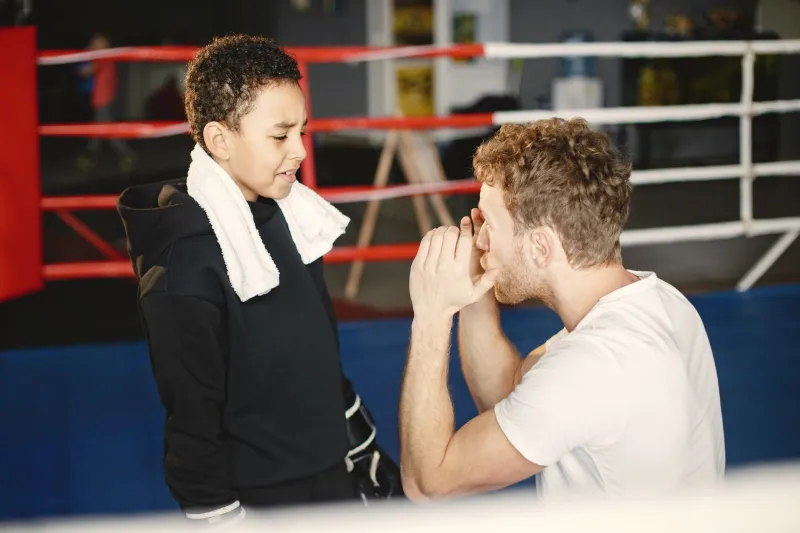
Our coaches keep the immediate debrief short and steady. A hand on the shoulder, a couple of sentences, no tactical lecture in a noisy hall with spectators filing past. The message is almost always the same: you did the work, you'll be alright, we'll look at it properly on Tuesday.
That last part matters. It tells a disappointed boxer that the bout isn't over and done with — it's material. There's a next step, and it has a day attached to it.
The walk back through the hall
This is harder than the bout itself for some kids. Well-wishers saying 'you were robbed', clubmates offering hugs, the other boxer's family being perfectly lovely, a stranger ruffling their hair. All of it well meant, all of it exhausting.
It helps to have a line ready. Something like 'thanks, I'll be back in the gym Monday' gets them through the room without having to relive every round. If you're a parent, walk beside them rather than in front. Don't fill the silences.
The car journey home
Here's our advice, gathered from coaches and from parents who've done this a dozen times: let the first ten minutes be quiet if that's what they want. Put the radio on. Don't re-referee the bout from the driver's seat.
Then ask one question — 'do you want to talk about it, or shall we leave it till tomorrow?' — and respect the answer. What you're avoiding, specifically, is the running commentary that starts with 'you should have' and ends with 'the judges'. Judging in amateur boxing can be debated until dawn and it changes nothing.
Also worth avoiding: 'it doesn't matter'. It does matter. They trained for it. Acknowledging that is kinder than pretending.
Sunday is the flat day
Nobody warns families about Sunday. The adrenaline's gone, the bruises have come out, and there's a strange emptiness where the bout used to be. Boxers often sleep badly, eat too little or too much, and go very quiet.
Keep it ordinary. A decent breakfast, a walk, something that isn't boxing. Don't schedule a big family lunch where four relatives ask how it went. If they want to watch the footage at 11pm, gently park it — that's a job for the coach, in daylight, with a pause button and someone who knows what they're looking at.
Watching it back properly
Midweek, the coach and boxer sit down with the video. The format is deliberately simple: two things done well, one thing to work on. Not a list of failures — a list you can actually use.
egThe difference between 'I lost' and 'I'm a loser' is the whole game here, and footage helps separate them. You can see a good jab in round one even if the decision went the other way.
The first session back
We like boxers back in the gym quickly — usually within two or three days, and always by choice rather than instruction. The session will look normal. Warm-up, skipping, bags, pads, maybe some light technical sparring later in the week. Nobody gets a sympathy session and nobody gets a punishment one either.
What coaches watch for is simple. Do they come back? Do they make excuses or do they ask questions? A boxer who comes in on the Monday after a defeat and asks to work on their guard is telling you everything you need to know about them.
What to say, and what to bury
Say: 'That was a hard one and you got through it.' Say: 'Your coach rates you and so do I.' Say: 'What's the next one?'
Bury: 'He was robbed.' 'You weren't trying.' 'Maybe this isn't for you.' And please bury any quiet comparison with another boxer in the club, even a favourable one. Kids hear it.
When a loss is actually a good sign
Sometimes a defeat means a boxer has stepped up a level, taken a short-notice bout, or fought someone older and heavier. Those are the losses that build careers. We've seen boxers lose well and gain more confidence than they'd have got from an easy win — because they found out they can take a hard round and stay standing.
The long view
Amateur records are patchy by design. Look at the card of almost any experienced boxer at Earlsfield ABC and you'll find a few Ls scattered down it. What you won't find is anyone who got there without one.
The hardest round is always the one after. It's also where a club earns its keep — in the car park, in the changing room, and on the Tuesday session afterwards. That's when we find out what a boxer is made of, and honestly, it's usually more than they think.